
- in Dehumidifier , Garage by David Miller
Dehumidifier for an Unheated Garage: How to Choose
An unheated garage needs a dehumidifier that can operate at its lowest expected temperature, remove enough moisture and dispose of that moisture outside the space. Measure the conditions before buying: a wet car, regular door opening and an actual roof leak present different problems.
For a cold garage with a suitable exhaust route, compare the Ecor Pro EPD30 and EPD50. These ducted desiccant models vent moisture as humid air. They are installation-oriented options, not ordinary bucket dehumidifiers. If you cannot install the wet-air exhaust, choose another arrangement rather than running one with the exhaust left indoors.
As an Amazon Associate I earn from qualifying purchases. Amazon links below can earn a commission. They are model-specific availability searches; an exact matching offer is not guaranteed.
Start with temperature and the source of the water
Use a thermometer and hygrometer to check conditions where the unit will operate. Include cold overnight periods, not just the warmer hours when you work in the garage. Compare that low temperature with the exact model’s manual.
Investigate obvious water entry first. A roof leak, leaking pipe or surface-water ingress needs its own repair. A dehumidifier can help manage airborne moisture, but it does not repair the source. If you need a wider technology comparison, see our desiccant dehumidifier guide.
Compare two ducted desiccant options
| Specification | Ecor Pro EPD30 | Ecor Pro EPD50 |
|---|---|---|
| Removal at 80°F and 60% relative humidity | 13 pints/day | 21 pints/day |
| Operating range | −4°F to 104°F | −4°F to 104°F |
| Rated power in the US manual | 350 watts | 550 watts |
| Supply in the US manual | 120 volts, 60 Hz | 120 volts, 60 Hz |
| Moisture disposal | Wet-air exhaust duct | Wet-air exhaust duct |
The removal figures apply to those stated test conditions. They do not promise the same extraction rate in a freezing garage. The operating range describes where the machine is rated to run, not a moisture-removal curve at every temperature and humidity.
Model names need care too. The EPD50’s “50-pint” marketing includes a comparison with a compressor dehumidifier; its separate specification sheet lists 21 pints/day at 80°F and 60% RH. Compare published capacities under matching conditions rather than assuming model labels mean the same thing.
Ecor Pro EPD30: lower rated power for a modest load
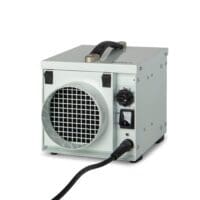
The EPD30 is the lower-capacity option in this pair. Consider it when the moisture load is modest, a suitable wet-air exhaust can be installed and lower rated power matters. That is a starting point for sizing, not a promise that it will dry every single garage.
Door opening, air leakage, wet vehicles and your target humidity affect the load. If conditions are demanding, obtain sizing advice before buying. A smaller appliance that cannot keep up is poor value even if its rated power is lower.
Check Amazon availability for the Ecor Pro EPD30. Confirm the model and electrical rating; do not substitute a similarly named unit without checking its manual. You can also check the manufacturer’s North American retailer directory.
Ecor Pro EPD50: higher capacity and a different installation choice
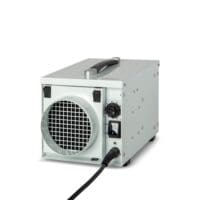
The EPD50 offers a higher published removal rate under the same test conditions. Compare it when the smaller model may be undersized or when its ducting arrangement better suits the installation. Its higher rated power also matters when estimating electricity costs.
Check the installation manual and accessory requirements before ordering. The larger model number alone is not a sizing method, and the EPD50 is still a ducted installation rather than a portable tank unit.
Check Amazon availability for the Ecor Pro EPD50. Verify the full model and included components. If no matching offer appears, use the manufacturer’s retailer directory rather than buying an unrelated search result.
Budget for installation as well as the appliance
Plan the humid exhaust route before placing an order. Follow the manufacturer’s duct sizing, length, routing and termination instructions. Do not send the wet air into another enclosed part of the building and expect the moisture to disappear.
For an alternative with a condensate drain, check whether freezing could obstruct drainage. For a tank model, work out how often you can empty it. Moisture disposal determines whether the setup is practical.
Keep required building ventilation and any combustion-appliance air supply intact. Reducing unwanted damp-air entry must be considered alongside those requirements. The cited US manual specifies an earthed supply and does not allow an extension cord; check the instructions supplied with your exact unit.
Estimate running costs with your electricity tariff
At a constant 350-watt draw, eight hours would use 2.8 kWh. At 550 watts, eight hours would use 4.4 kWh. Multiply the kWh figure by your electricity tariff for an example cost.
These are arithmetic examples at rated power, not measured bills or predictions. Actual use depends on controls, conditions and running time. A lower-power machine that runs longer is not automatically cheaper for a particular garage.
Questions to settle before buying
Will any desiccant dehumidifier work below freezing?
No blanket assumption is safe. Check the exact model’s operating range. These two Ecor Pro models have a published range down to −4°F; that does not establish the rating of another desiccant unit.
Can I use one without an outside exhaust?
These models need their humid exhaust routed according to the installation manual. For a setup without that route, investigate a suitable tank or drain model and verify its temperature limits.
How large a unit does my garage need?
Floor area alone is insufficient. Start with temperature, moisture entry, air leakage, door use and the humidity you need to maintain. For more background, see our dehumidifier sizing guide, then confirm sizing against the selected model’s requirements.
The buying decision
Choose by lowest expected temperature, realistic moisture load, an achievable exhaust or drain route and running cost. Compare the EPD30 and EPD50 when a ducted cold-garage installation is practical. If a portable tank unit is what you need, verify that exact alternative’s temperature range and drainage before treating it as equivalent.
Sources and editorial method
This guide uses manufacturer specifications and installation requirements, checked November 8, 2026. We have not field-tested the units. Seller offers and stock can change.

